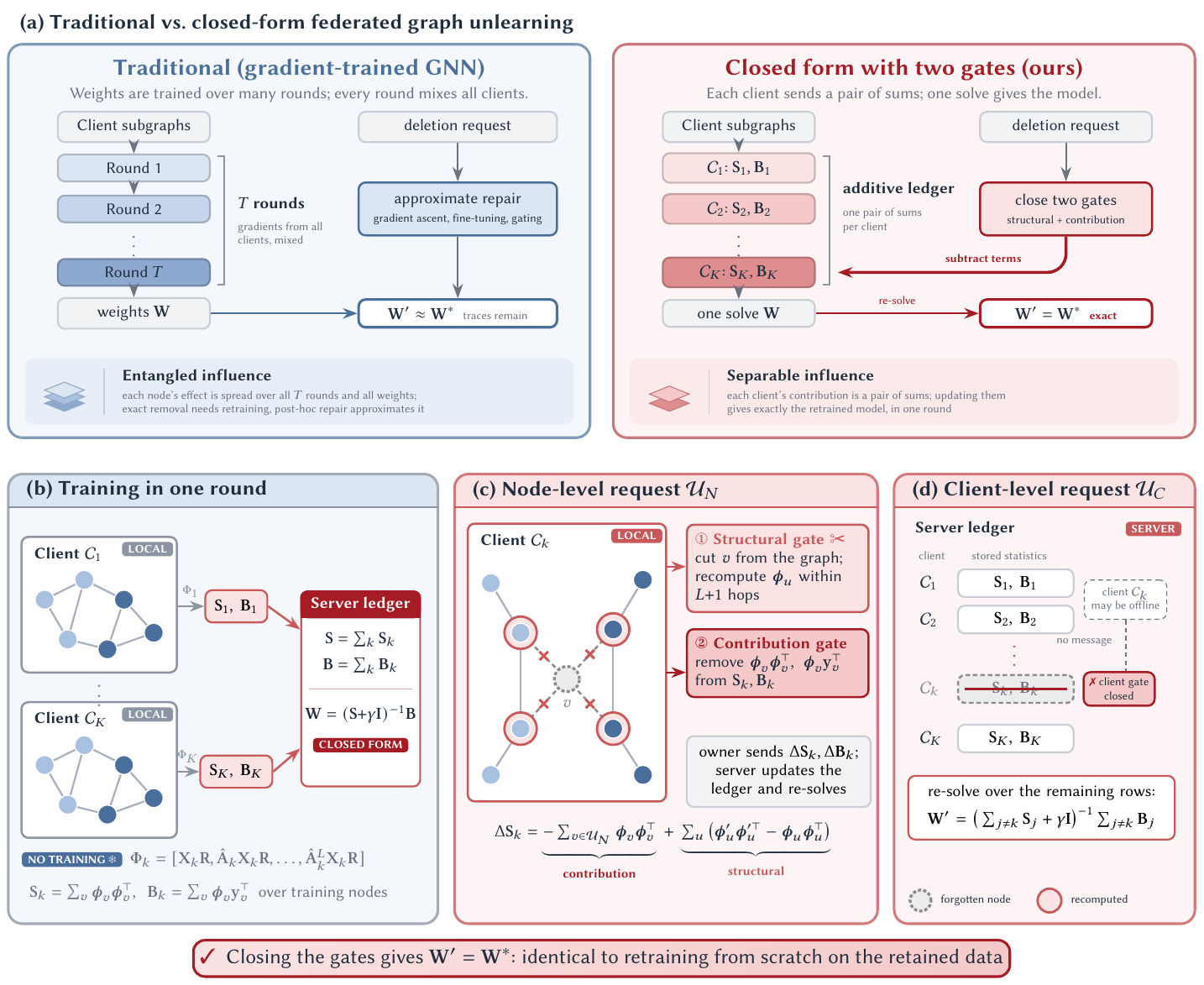
Graph neural networks trained in federated settings retain information about the nodes they were trained on.
When a node or a whole client asks to be forgotten, approximate methods leave a trace that can still be
detected. We describe a federated graph learner whose unlearning is exact: after a node-level or
client-level request, the model equals the model retrained from scratch on the remaining data.
Each client computes node features with a fixed propagation that has no trained parameters, and the server
fits a ridge classifier from statistics the clients send. Deleting a node on a graph changes two things: its
own contribution to the statistics, and the features of its neighbours. A contribution gate and a
structural gate handle the two changes; we prove that both are needed and that together they give
the retrained model. A node request involves only the client that owns the nodes; a client request needs no
message from the removed client.
On seven benchmarks, the unlearned model matches retraining up to floating-point rounding in every check,
membership attacks on the deleted data give exactly the retrained model's score, and a request takes a
fraction of a second. We also measure what the shared statistics reveal, and how much protection a
secure-aggregation view provides.